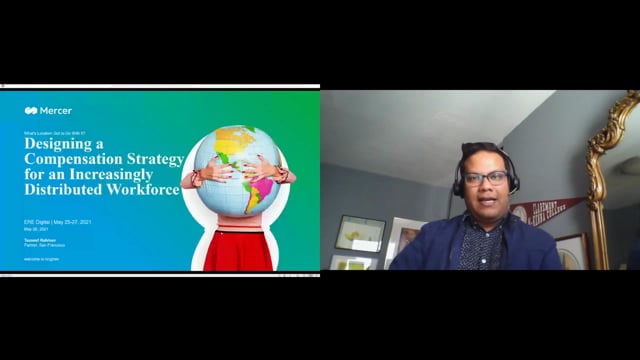
Designing a Compensation Strategy for an Increasingly Distributed Workforce
May 26, 2021 · ERE Digital Spring 2021 ·
Speakers

About this video
Pay design has become one of the thorniest problems in distributed work, and the answers organizations are landing on vary far more than the headlines suggest. Survey data drawn from roughly six hundred US organizations shows where companies actually stand on geographic restrictions, remote pay-setting, and relocation adjustments, alongside case examples from companies like Uber, Pinterest, and Slack that illustrate different responses to flexible work.
- Flexibility is described as multidimensional, covering not just where people work but when, how, what, and who does the work, with most organizational attention still focused narrowly on location.
- A large share of organizations remain undecided on whether hybrid or fully remote employees will face geographic restrictions, though a majority that have decided require work within an approved jurisdiction or office radius.
- For setting pay of fully remote workers, common approaches include pricing to the home location, a flat national rate, the recruiting labor market for that role, or simply the rate of the nearest office, with the last option remaining surprisingly common even though it does not reflect where the person actually works.
- Most organizations report they will not cut pay when an employee relocates to a lower-cost area, though some freeze pay above market or apply reductions; a few well-known employers publicly adjust pay both ways citing internal equity.
- Cost of labor, not cost of living, drives most compensation strategy, with living wage serving at most as a secondary floor rather than the primary driver.
- Geographic pay structures typically use three to five tiers, with the lowest tier often no less than about seventy percent of a premium market like the Bay Area or New York, though variation is wider outside tech.
- Work-from-home stipends, sometimes reaching into five figures annually, are used by some employers to soften the effect of geographic pay cuts.
- A four-step framework for building a comp strategy starts with segmenting the workforce by whether jobs require physical co-location, then weighing labor market scope against business criticality, and using a two-by-two matrix of geographic reach and labor demand to decide where national or highest-market pay structures make sense.
Talent acquisition's role in this shift goes beyond sourcing: educating candidates on the difference between cost of labor and cost of living, and feeding real-time signals about how hard or easy roles are to fill, gives compensation philosophy a much stronger foundation than assumptions about what a role "should" pay.