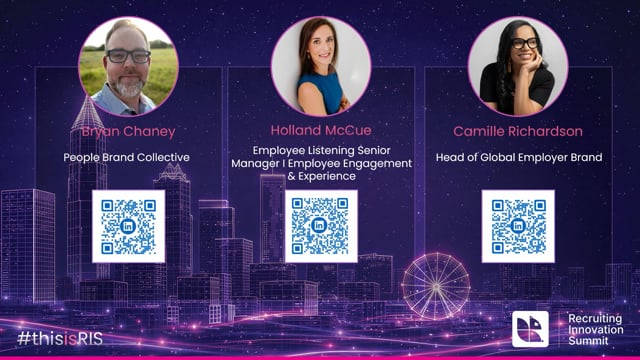
Employer Brand is Your Experience Brand
May 5, 2026 · ERE Recruiting Innovation Summit Spring 2026 ·



About this video
Employer brand is often treated as a marketing exercise: a tagline, a careers site, a few social ads. The real substance of a brand lives somewhere else entirely, in what people actually experience once they walk through the door, and whether that lived reality matches what was promised during recruiting.
A story from inside one hyper-growth company illustrates what happens when it doesn't. Onboarding surveys and exit surveys turned up the same five reasons, over and over, for why people joined and why they later left. Career growth was the biggest gap: the external story sold rapid advancement from intern to director, a path that applied to a tiny fraction of hires, while most employees experienced flatter, more lateral careers. Once the organization matured past its early growth phase, the old narrative kept circulating anyway, and the mismatch between message and reality started showing up as disengagement and attrition.
Several ideas run through the conversation:
- Employer brand is not owned by one team. It sits across talent acquisition, marketing, communications, HR, and ultimately every employee, through how they treat each other day to day.
- Alignment between promise and experience improves quality of hire. Candidates who already understand the reality of a role, good and bad, are more likely to succeed and stay. Employer brand should repel the wrong fits as much as it attracts the right ones.
- Annual engagement surveys often lag behind what's actually happening. Asking hiring leaders for their team-level survey results, review-site data, and concrete plans for improvement produces a far more useful story than a company-wide brand statement.
- One company now publishes its internal engagement survey results, including the negative findings, directly on its careers site, framing where it's improving rather than pretending everything is solved.
- Recruiting cannot fix what a business is unwilling to face. When offer acceptance drops or time-to-fill stretches, the instinct is often to spend more on ads rather than address an underlying experience problem.
The goal isn't getting people to buy into a story. It's telling a story real enough that people can see themselves in it, imperfections included.
Practical suggestions include pushing past press-release language with senior leadership to understand what's actually being planned, and treating employee listening data as raw material for recruiting narratives rather than a compliance exercise.