Growth Hacking For Sourcers
September 21, 2020 · SourceCon Digital Fall 2020 ·
Speakers

About this video
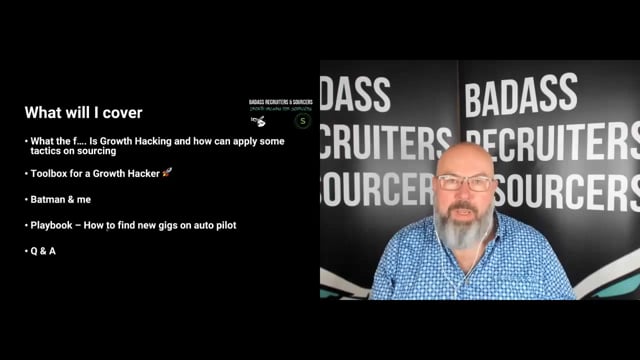
Growth hacking started as a marketing discipline built on data, experimentation, and rapid iteration, and the same mindset applies directly to sourcing. Rather than treating outreach as a fixed process, small experiments—testing subject lines, personalization, or timing—can be scaled up when they work and killed when they don't.
The pirate funnel (awareness, acquisition, activation, retention, revenue, referral) offers a way to measure where a sourcing campaign leaks: how many people are reached, how many open a message, click a link, re-engage, reply, and eventually refer others. Tracking each stage reveals the one metric that matters most and where effort should go next.
A simple scoring method—rating ideas on relevance, availability, and scalability—helps rank which experiments to try first, rather than guessing. Case studies from early referral and growth campaigns (a cloud storage company's referral rewards, a home-rental platform's reverse-engineered network effect, and an airport's psychological fix for perceived wait times) show how small, clever changes in incentive or perception can outperform expensive fixes.
On the tools side, several under-the-radar platforms get walked through in detail:
- A link-shortening tool that adds tracking pixels and call-to-action pop-ups for retargeting on Facebook
- An automation platform that chains scraping and outreach actions together into multi-step "recipes" across LinkedIn, Facebook, and Twitter
- A LinkedIn automation tool with cloud-based campaigns, webhook integrations, and inbox management for connection requests and follow-ups
- A dynamic image and GIF generator that personalizes LinkedIn messages with names, titles, and company details, extending into landing pages and Facebook ad retargeting
- A video personalization tool that inserts a viewer's name and image into video messages at scale, then routes them through email or outreach platforms
A segmentation approach ties it together: top-tier candidates get fully handwritten, highly personalized outreach; a middle tier gets persona-based semi-automation; the broader pool gets automated but still relevant messaging. The result is a layered outreach strategy where quality decreases and quantity increases moving down the funnel, without sacrificing relevance at any level.