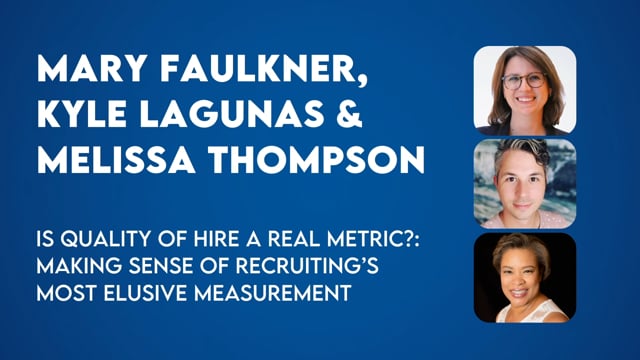
Is Quality of Hire a Real Metric? Making Sense of Recruiting’s Most Elusive Measurement.
May 15, 2024 · ERE Recruiting Conference Spring 2024 ·



About this video
Quality of hire gets brought up in nearly every conversation about recruiting metrics, yet almost no one in a room full of talent acquisition professionals can say they actually measure it. A panel discussion works through why that gap exists and what it would take to close it.
The disagreement starts with a basic question: is quality of hire even a legitimate metric, or is it too subjective to be useful? One view is that talent acquisition doesn't control the outcome, since hiring managers make the final call, so recruiting shouldn't be judged on it. The counterargument is that leadership doesn't care who owns the decision; they want an answer regardless, so the smarter move is to define the metric on your own terms before someone else defines it for you.
Several practical points come out of the discussion:
- A workable quality of hire score can combine multiple signals, such as retention, hiring manager satisfaction, and employee satisfaction, weighted into a single number rather than relying on one input.
- Self-reported data from hiring managers and new hires carries bias in both directions, but that bias tends to balance out at scale and can still reveal meaningful trends.
- Definitions of "quality" differ by department and by company, so the number only means something once stakeholders agree on what a good hire actually looks like.
- Treating quality of hire as a standalone score misses the point; it works best alongside time to fill, cost per hire, and turnover data as part of a larger performance picture.
- The metric functions less as a scorecard and more as an alignment tool, giving recruiters and hiring managers a shared, data-backed way to talk about what's breaking down in the process.
- Timing matters. Measuring too early produces overly positive results, while measuring later, after a year or promotion cycle, tells a different and sometimes more useful story about long-term fit.
The overall guidance is to stop waiting for a perfect measurement and start with something imperfect, since even a rough version of the metric opens up conversations between recruiting, hiring managers, and the business that otherwise never happen.