Mitigating AI Implementation Risks as an Early Adopter in Healthcare
November 10, 2026 · ERE Recruiting Innovation Summit Fall 2026 ·
Speakers

About this video
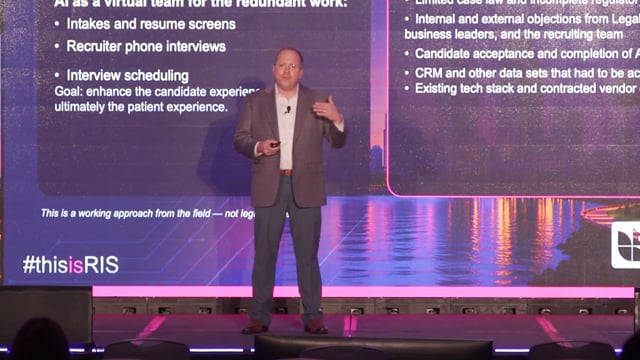
Healthcare recruiting has run the same way since the 1970s, and agentic AI is upending it faster than most legal and compliance teams can process. Drawing on two separate AI rollouts inside large healthcare organizations, this account lays out exactly how to introduce AI sourcing and interviewing without getting blocked by legal, and how to prove the technology is being used responsibly rather than recklessly.
Key elements covered:
- A four-box mitigation framework: mapping known legal exposure under Title VII, ADA, EEOC and state AI-interview laws (currently New York, Illinois, California), quantifying residual risk, building compensating controls, and actively monitoring outcomes.
- The single non-negotiable rule for getting legal sign-off: no hiring decision is ever made by AI alone. A human reviews every transcript, scoring rubric and recommendation before a candidate moves forward.
- A "prove it or park it" test for deciding which tasks are ready for AI (intake, resume screening, phone screens, scheduling, and now sourcing) versus which should wait (full ownership of hiring decisions).
- Forecasting legal objections before they're raised, including bias testing, disclosure requirements (a simple on-screen notice that candidates are speaking with a virtual agent), and vendor liability clauses that shift risk onto AI vendors.
- Practical contract advice: negotiating credit-based, month-to-month agreements with rollover credits so spend scales up or down with hiring volume.
- Guidance on calibrating AI grading rubrics, since AI screening tends to be generous and lacks the judgment a seasoned recruiter applies to borderline candidates.
- Data quality fundamentals, including building a direct, bidirectional feed between AI tools and the applicant tracking system, and using clean, continuously updated candidate data sets for sourcing.
Results from a rapid rollout include thousands of completed AI-driven interviews, most happening outside business hours, high candidate acceptance rates across clinical roles from pharmacists to dentists, and hundreds of recruiter hours reclaimed from redundant screening work. The approach treats risk forecasting as a core talent acquisition responsibility rather than something to hand off entirely to legal, with the goal of walking into compliance conversations already holding the answers to "what happens if we get sued."