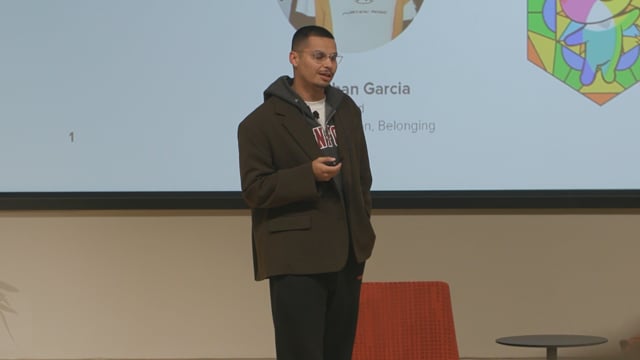
Navigating Inclusion: ERG Insights from the C-Suite to the Front Line
June 4, 2024 · Talent42 2024 ·
Speakers


About this video
Employee resource groups are frequently treated as a nice-to-have: a happy hour, a guest speaker, a line item that's easy to cut. A different framework treats them instead as engines of connection, retention, and leadership development, with a structure built around three principles: commitment, care, and collaboration.
At one company running eleven ERGs with dozens of volunteer leaders, the guiding design question borrows from a museum built with no doors and no fixed entry point, meant to remove barriers for visitors approaching from any direction. Applied to ERGs, the same question becomes: how does a group remove barriers to entry so that anyone, regardless of how familiar or intimidated they are by the space, can walk in and find their way to the center?
The point of an ERG is never really the event calendar. Educational content, recruiting efforts, professional development sessions, and social gatherings are all vehicles, not the destination. The actual goal is deeper: psychological safety, emotional support, and a larger organizational capacity for empathy, especially for historically marginalized employees. Programs that ladder ERG work up to a broader diversity, inclusion, and belonging strategy avoid the trap of activity for its own sake.
An executive sponsor program pairs each ERG with a senior leader, ideally one who is genuinely engaged rather than a name on a slide. Real sponsorship does several things at once:
- Creates connections across the org chart with people a sponsor would never otherwise meet day to day
- Surfaces problems and cultural blind spots early, before they become retention risks
- Identifies future leaders, since ERG volunteers are already doing extra, unpaid, high-visibility work driven by genuine passion
- Builds trust that pays back in loyalty, particularly after moments of collective strain or crisis
Underneath the framework sits a simple argument: safety enables risk-taking, and risk-taking is what produces stronger performance and stronger careers. Employees who feel free to be themselves, rather than fitting a preset mold of what their role or industry is supposed to look like, are the ones companies retain and promote. Treated seriously, ERGs become one of the clearest signals of whether a company's stated values match its daily practice.