Navigating Trends in the Labor Market
May 25, 2021 · ERE Digital Spring 2021 ·
Speakers

About this video
The labor market recovery has been anything but even. Millions of jobs came back quickly after last year's collapse, but progress stalled hard in April, and the reasons why matter for anyone trying to hire right now.
Key patterns showing up in the data include:
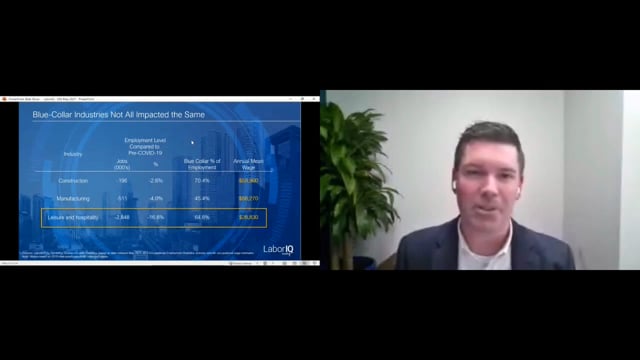
- Leisure and hospitality remains furthest from full recovery, still down roughly a fifth of pre-pandemic jobs, while construction and manufacturing have nearly closed the gap.
- Hourly worker employment rebounded fast through last year, then went flat. People with hourly jobs have largely stopped re-entering the labor force, even as demand for restaurant, hotel, and manufacturing workers spikes.
- Wage increases are already showing up as a response, with some manufacturing employers raising pay by two dollars an hour or more just to attract applicants.
- Extra unemployment benefits, combined with regular state insurance, allow some workers in certain states to collect more annually than they'd earn in a typical blue-collar job, a gap driving a growing number of states to end the extra benefits early.
- Occupations like couriers, delivery drivers, and management consulting saw hiring surges tied directly to pandemic conditions, and some of that demand is likely to soften as reopening continues.
- Healthcare, tech, and legal roles remain tight for a different reason: unemployment in those fields is already near zero, meaning most hiring has to come from luring people away from existing jobs rather than pulling from the unemployed.
- Remote work expectations are shifting negotiating leverage toward candidates, with pay gaps for the same role, such as experienced software developers, varying sharply by metro area and pushing some employers toward remote hiring or outsourcing.
- Recovery has landed unevenly by geography, with the Northeast, parts of the Midwest, and sections of the West Coast lagging behind the Southeast and Southwest, partly tied to COVID restrictions and partly to longer-term population shifts.
- Women left the labor force at a noticeably higher rate than men at several points over the past year, tracking closely with school closures and childcare disruptions.
Together these trends point to a hiring environment where job openings are plentiful but the available labor supply hasn't kept pace, particularly for wage-sensitive and hourly roles, setting up a genuinely difficult stretch for recruiters through the second half of the year.