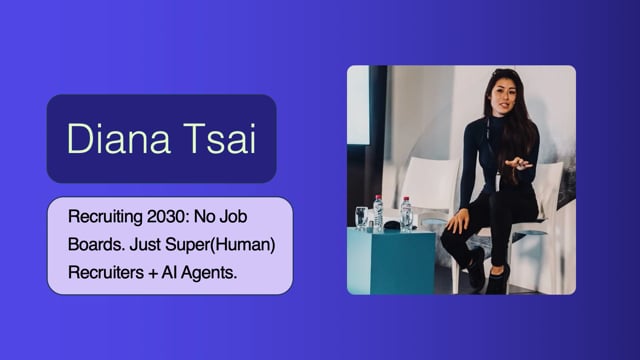
Recruiting 2030- No Job Boards. Just Super(Human) Recruiters + AI Agents
April 30, 2025 · ERE Recruiting Innovation Summit Spring 2025 ·
Speakers

About this video
Hiring today runs on ten-second resume scans and phone screens that reach a fraction of applicants, while the strongest candidates often go unseen simply because they applied after a recruiter logged off. Drawing on field deployments across retail, healthcare, logistics, education and hospitality, the case is made that the problem was never a shortage of talent but a matching failure baked into legacy hiring tools built to filter and reject rather than discover.
Several company examples illustrate what changes when AI interviewing agents are deployed alongside recruiting teams:
- A delivery and logistics company replaced its apply button with an AI interview, made resumes optional, doubled recruiter capacity, and cut turnover meaningfully while generating strong first-year ROI.
- A disability services nonprofit used AI interviewers to reach far more candidates than manual outreach allowed, surfacing applicants from historically overlooked communities.
- A retail company ran a blind test where hiring managers reviewed AI-interviewed candidates without knowing it, and called the resulting talent pool the strongest they had ever seen.
- A healthcare company broke a five-year plateau in call-center turnover by training AI interviewers to identify high-retention competencies.
- Another healthcare organization trained AI interviewers on real performance review data for front-desk roles, cut turnover nearly in half, and expanded the approach to executive hiring.
- A nonprofit filled teaching roles far faster than before, keeping classrooms staffed in underserved communities.
The underlying math is simple: manual pipelines typically screen a small share of applicants, while AI-driven top-of-funnel interviewing can reach the large majority, freeing recruiters to spend their limited time building relationships with the highest-fit, highest-retention candidates rather than guessing from thin signals.
Looking ahead, hiring is expected to move through stages: first, AI removes administrative burden and gives recruiters and hiring managers back their time; next, multi-agent systems coordinate sourcing, redeployment, stay interviews and exit feedback under an orchestrating "AI manager"; finally, a universal interviewer concept could match laid-off or at-risk workers to open roles across employers in real time, offering a form of safety net and internal redeployment before layoffs even happen.
Early prototypes were rigid and repetitive; current versions probe, follow up and respond with something closer to coaching, paired with an analyst layer that turns unstructured conversation into structured, role-specific competency signals for recruiting teams.