Set The Pace, Win The Race – How To Achieve Maximum Talent Velocity
March 9, 2022 · SourceCon Digital Spring 2022 ·
Speakers

About this video
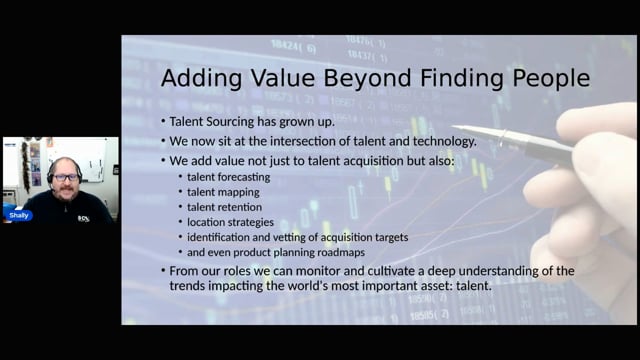
Sourcing has moved well past downloading resumes. It now sits at the intersection of talent, technology, and decision support — combining talent intelligence, market forecasting, retention analysis, and outreach into what can be called talent velocity: the speed at which an organization can attract, engage, and move candidates before they take another offer.
Several practical shifts make this possible:
- Talent forecasting that looks beyond city-level labor data to what skills graduates are learning, how job titles are evolving, and what kinds of companies candidates want to work for — building candidate personas around online presence, not just LinkedIn.
- Retention analysis that cross-references exit interviews with requisition and hiring data to find where attrition is concentrated, since exit surveys alone are incomplete and often unreliable.
- Location and workforce strategy, including cases where sourcing data on the local talent pool influenced decisions about keeping a facility open or identifying acquisition targets.
- A scoring rubric that rates candidates zero to three points across five to seven job-specific criteria — skills, tools, community involvement, keyword density — with a defined passing score. Candidates who clear the threshold get fast-tracked directly to a hiring manager screen, skipping recruiter review and preliminary steps entirely. Those who don't pass aren't rejected; they simply move through the normal process. This alone can cut a multi-hour, multi-step hiring workflow down to one or two hours of a hiring manager's time.
- Workload balancing based on live requisition reporting, so sourcing support is assigned to reqs that hit a priority threshold rather than split evenly regardless of how fast or slow each one is moving. Sourcers are attached to business units, to evergreen pipeline-building for hard-to-fill roles, or deployed as an ad hoc response team to give a stalled requisition a push.
The underlying argument is that sourcing's real value isn't a hire count — it's decision support. Widening a hiring manager's candidate slate, even with people who don't get the job, gives them the confidence to make a call. That's why sourcing success looks different from recruiting success, and why treating the two the same misses the point.