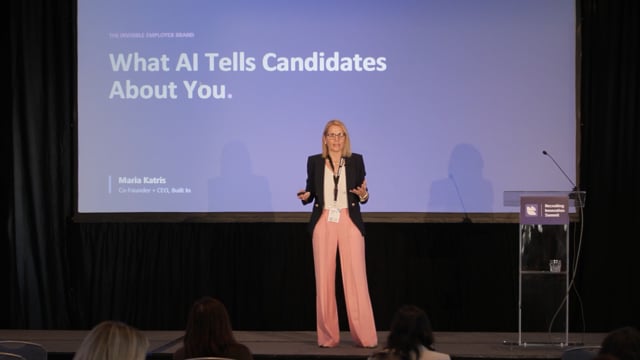
The Invisible Employer Brand and What AI Tells Candidates About You
November 10, 2026 · ERE Recruiting Innovation Summit Fall 2026 ·
Speakers

About this video
Candidate behavior consistently mirrors consumer behavior, and the shift toward AI-driven research is already reshaping the hiring funnel. Job seekers now use tools like ChatGPT and Claude the same way they research restaurants or products, forming opinions about employers before ever reaching a career site or responding to a recruiter.
Two concepts frame this problem: visibility, whether a company even appears when a candidate asks AI about employers in a given market or role, and reputation, what AI says about a company once it's been found. Both are already influencing application rates, sourcing response rates, and offer acceptance, often invisibly, because talent teams have no way to measure what's happening inside an AI conversation.
Several patterns show up repeatedly when employers start examining this:
- Companies often don't know who they're really competing with in AI-generated shortlists. A financial services firm hiring retail staff, for example, may be losing candidates to a beauty retailer down the street without ever realizing it.
- AI tends to aggregate third-party review sites into a single narrative, pulling heavily from ex-employee reviews and sometimes surfacing outdated information, like a CEO or CTO who left years ago.
- For employers with both corporate and high-volume frontline workforces, AI often can't distinguish which reviews apply to which roles, so an executive candidate researching the company might see complaints meant for a call center or manufacturing line.
- Career sites account for a small share of what AI actually cites, so investment there has limits; accurate, well-distributed content on third-party platforms carries more weight with language models.
The fix isn't abandoning employer brand work already underway, but pairing it with measurement and distribution. That means auditing current visibility and reputation role by role and market by market, producing accurate, fact-based content, FAQs rather than long-form storytelling, built for how AI systems parse information, and pushing that content onto the third-party sources large language models cite most often. Waiting months to perfect an employer value proposition before distributing it is treated as a mistake; distribution needs to happen in parallel, because candidates are already forming opinions now, not after a career site redesign ships.