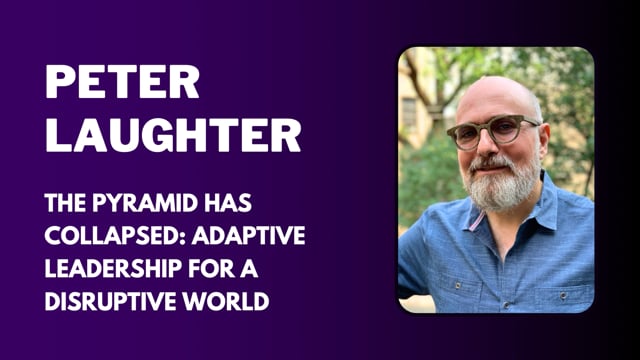
The Pyramid has Collapsed: Adaptive Leadership for a Disruptive World
October 23, 2024 · SourceCon Fall 2024 ·
Speakers

About this video
Command-and-control leadership was built for a slower world, and that world is gone. Organizations still run on a management structure thousands of years old, one designed to keep illiterate peasants planting the right crops, and it is failing under the weight of modern complexity. Large-scale transformation efforts, from mergers to digital overhauls, fail at a persistently high rate year after year, wasting hundreds of billions of dollars annually, while a majority of employees worldwide remain disengaged, doing the bare minimum.
The case for a different approach opens with Martin Luther King's speech at the March on Washington, planned as a message about America's broken economic promises. Midway through, gospel singer Mahalia Jackson called out from the crowd, telling him to speak instead about his dream. He abandoned his prepared remarks on the spot and gave the speech now remembered as one of the greatest in American oratory. The same adaptability shows up in King's decision to give up armed protection after a civil rights colleague, Bayard Rustin, convinced him that carrying a weapon undercut the movement's message of nonviolence.
Several structural problems explain why rigid hierarchies keep failing:
- Hierarchical mirroring, where only opinions from equal or higher rank get valued, cutting leaders off from frontline knowledge
- The "iceberg of ignorance," in which senior executives are aware of only a small fraction of the problems an organization actually faces, while frontline workers see nearly all of them
- Information that flows downward through a hierarchy but rarely flows back up, leaving executives to make decisions on incomplete or distorted data
- Fear-driven silence, where subordinates withhold bad news rather than challenge a leader's pet project
A recruiting business example illustrates the fix: a costly, complicated plan to repair a damaged online reputation was set aside in favor of a much simpler fix proposed by a junior team member, one who recognized that the real problem was poor communication with candidates rather than the assessment process itself. That simpler, front-line solution worked immediately.
The throughline is that authority distributed closer to the front lines, combined with a willingness to abandon plans when better information emerges, outperforms rigid top-down control, especially as technological change accelerates faster than most organizations can currently absorb.