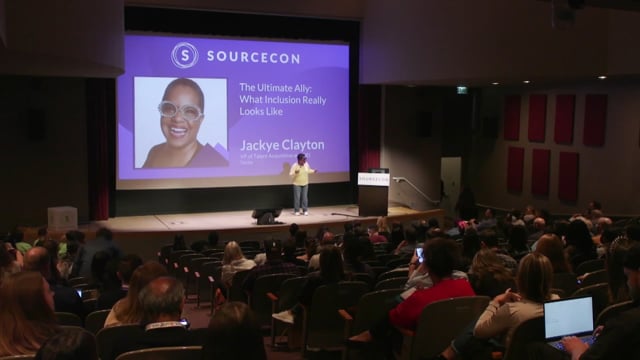
The Ultimate Ally: What Inclusion Really Looks Like
October 18, 2022 · SourceCon Fall 2022 ·
Speakers

About this video
Being an ally is not something a person can claim for themselves, and it stops being genuine the moment it only extends to one favored individual instead of everyone who needs support. The material builds around a simple acronym tied to lemons: when talent acquisition work turns bitter, the response is to make something useful of it rather than wait for conditions to improve on their own.
The framework covers several concrete practices:
- Learning continuously matters because recruiting systems, scorecards, and accounting methods were never built with underrepresented candidates in mind. Widely cited statistics about hiring behavior often trace back to decades-old studies still being recycled as though they were current.
- Empathy means picturing people in their own shoes rather than turning someone else's struggle into a comparison with one's own experience. It also means advocating for those missing from the table instead of guessing what they need.
- Managing up requires pushing hiring managers past vague requests for "diverse candidates" toward accountability: recurring status conversations, real reporting on where candidates drop out of a pipeline, and a willingness to challenge decisions that look biased, even in a first week on a new job.
- Operationalizing the commitment shows up as recurring interview training, bias mitigation built into every candidate debrief, and a standing line item for inclusion in every talent acquisition meeting, rather than a one-time initiative that fades once a goal is set.
- The work has no finish line. A workplace does not arrive at a fixed state of being inclusive; the effort repeats, and that repetition is the point.
Recruiters' obligation runs to the business and to candidates left out of consideration for reasons unrelated to the job requirements, not to whichever hiring manager is in a hurry. Personal career stories involving chances given without full qualifications, stretch assignments, and bosses who advocated for raises or promotions before someone felt ready connect to a larger point: opportunity, not perfect credentials, builds careers, and extending that opportunity is what recruiters owe candidates.
It's our job to stand up for those who are not at the table when life-altering decisions are made.
Inclusion gets treated as a lifelong verb rather than a fixed achievement, planted like a seed for shade someone else may eventually sit in.