Tool Talk Sponsored By HackerRank
October 19, 2021 · SourceCon Digital Fall 2021 ·
Speakers

About this video
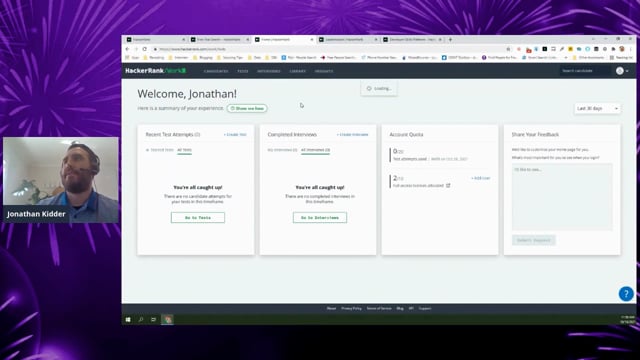
A live walkthrough of HackerRank covers how recruiters use the platform to validate technical talent after the sourcing and screening stages, with a demo account showing tests, candidate reports, and admin features in detail.
Key parts of the platform demonstrated include:
- Creating a test by choosing a role — backend, full stack, cloud engineer, cybersecurity, data engineer, and dozens more — and selecting which skills to assess, such as problem-solving, code quality, system design, or technical communication.
- Pulling questions from a searchable library filtered by job title, skill set, difficulty level, and recommended completion time, with insight data showing how other candidates performed on each question.
- Reviewing a completed candidate report, which shows time to completion, pass/fail by test case, difficulty breakdown (easy, medium, hard), and an automatic plagiarism flag built with a system developed alongside Stanford to detect copied code.
- Using built-in pipeline tracking similar to an internal ATS — tagging, rating, and moving candidates through stages — with the option to sync directly to an existing applicant tracking system.
- Reading dashboard-level analytics on test usage, drop-off rates, average scores, and interview activity, useful for admins deciding whether a test is calibrated correctly.
- Sourcing directly from HackerRank's public leaderboards, where developers who rank highly on coding contests can be approached about open roles.
Questions from the audience address practical concerns recruiters raise about assessment tools: whether soft skills like coachability can be measured through survey-style questions, why forward-looking potential still has to be judged through a phone screen and portfolio review rather than the platform itself, and how plagiarism detection separates copied code from standard, commonly known solutions. There's also a candid discussion of candidate experience — how lengthy or repeated testing drives strong candidates away, and why keeping an assessment to roughly thirty to ninety minutes, with only one or two questions, tends to hold up better than longer or multi-round testing processes.
Anything above ninety minutes, or three or four rounds of testing, is overkill.
Other topics touched on include editing and customizing questions, sharing PDF results with hiring managers or candidates, and the availability of a free fourteen-day trial with a set number of assessments included.