Unleashing Talent Velocity: High-Performance Team Building without Sacrificing Precision
June 3, 2024 · Talent42 2024 ·
Speakers

About this video
Building a recruiting engine that can hire at a punishing pace, without letting quality or accuracy slip, requires specific tradeoffs and habits rather than good intentions. Drawing on experience scaling a recruiting org through multiple funding rounds and headcount growth, the following practices cover how to set up a team, forecast capacity, and move fast without breaking trust.
- Execution earns trust first. Coming into a new company, credentials from previous employers count for little. Wins on the board, delivered quickly, are what earn the right to push back, ask for headcount, or challenge stakeholders later.
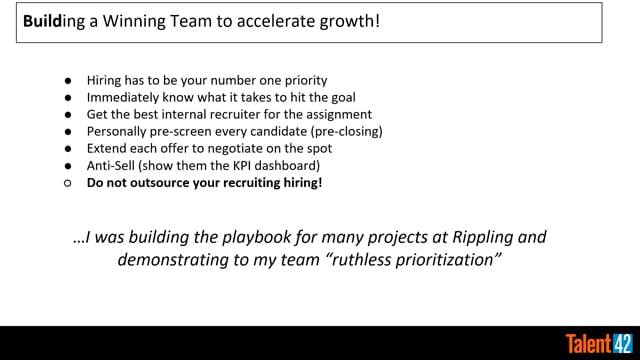
- Hiring the recruiting team has to be priority number one. That means checking a calendar weekly to confirm time actually matches stated priorities, and reverse-engineering every hiring goal back from the start date needed, through ramp time, to today.
- Put the strongest internal recruiter on the team, even if it means a fight. Pulling a top performer from another function to build the recruiting org, and giving that function a self-service sourcing strategy in return, pays off fast.
- Pre-screen every candidate personally when the team is small. It costs calendar time but produces enormous leverage at offer stage, since concerns and motivations are already known before an offer is extended.
- Build a capacity model early and evolve it. Starting with something simple, such as offer-accept targets, before moving to more predictive metrics like recruiter phone screens, keeps forecasting honest. Ratios for coordinator support, a mix of full-time versus contract recruiters, and a built-in buffer for attrition or spikes all belong in the model.
- Treat headcount for the recruiting team as one place not to be frugal. Under-resourcing recruiting slows every other function that depends on hiring.
- Ship rough processes fast and fix them later. Dashboards, intake forms, and escalation policies built in days rather than weeks give hiring managers clarity, and clarity is what actually produces speed.
- Use transparency as a trust mechanism. Weekly attainment charts, monthly red-yellow-green reviews, and pipeline reports shared openly let problems get flagged early instead of surfacing as surprises.
- Sometimes it pays to fulfill a data request you suspect is pointless. Doing the small favor, even without a resulting decision, builds credibility that pays off in future negotiations over priorities.
The overall approach favors instinct and iteration over lengthy deliberation: decide quickly, launch something imperfect, and adjust once real usage exposes the gaps.