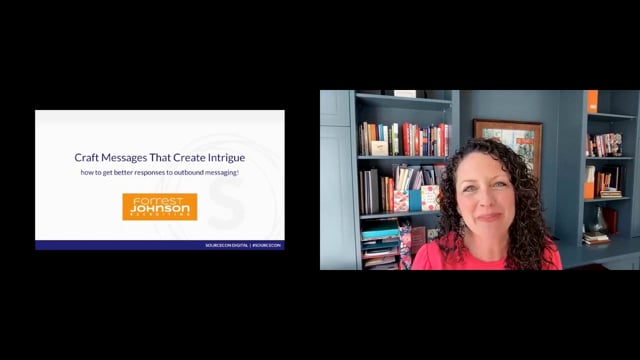
You’ve Got Mail! - How To Craft Messages That Create Intrigue
March 10, 2022 · SourceCon Digital Spring 2022 ·
Speakers
.png)
About this video
Getting a response to outbound recruiting messages starts long before you write a single sentence. Two decisions have to be made first: who exactly you're targeting, and what you want that person to do once they read your message.
Defining a candidate profile means going beyond title, keywords, and Boolean strings to consider the human element. Research on workers who experienced pandemic-era job instability shows passion and fulfillment now outweigh salary and security as top career priorities. Messages that tap into a candidate's aspirational identity, who they want to become, generate stronger responses than those built purely around a job description.
A clear call to action matters just as much as the audience definition. Sending a job description or application link as the ask sacrifices the chance to build a relationship, learn about the candidate, and shape their experience. A phone conversation, a request for a referral, or an invitation to network gives both sides more to work with than a link ever could.
Effective messages share several characteristics:
- Confidence in how the opportunity and the sender are presented
- Conciseness that respects the reader's time without stripping out intrigue
- Clarity about why the outreach is happening and what's being asked
- A compelling quality that treats the candidate as the hero of the story, not the recruiter or the company
Word choice plays a bigger role than most recruiters give it credit for. Swapping "job" for "opportunity" or "venture," "company" for "enterprise" or "industry leader," and leaning on adjectives like "skilled," "innovative," and "critical" helps a reader picture themselves in the role.
A useful way to structure a message is to treat it like a movie teaser trailer rather than the whole film: a subject line that intrigues, a brief introduction of sender and client, a short and vivid description of the opportunity, a nod to who the ideal candidate is, a simple call to action such as a scheduling link, and a warm, confident sign-off.
Specific examples show how small choices, mentioning a headquarters city, naming a client's industry, or describing a role as "multi-brand" and "high-growth" rather than generic, can create just enough intrigue to prompt a reply.