Preparing Your Recruitment Strategy for the 2025 Political Landscape
October 31, 2024 · Webinars ·
Speakers
.png)
About this video
A look at how the presidential election and the broader political landscape actually intersect with hiring, framed around objective labor market data rather than partisan spin.
The core argument: a US president has far less direct control over job growth and the economy than campaign rhetoric suggests. Presidential job creation numbers largely reflect where the economy already was in its cycle — administrations that inherit a weak economy tend to preside over growth, while those inheriting a strong economy often see slowdowns. This pattern holds going back through Carter, Reagan, Bush, Clinton, Obama and Trump.
Several structural realities matter more than who wins in November:
- A new administration takes roughly six months to ramp up any policy changes, and split control of Congress makes sweeping legislative shifts unlikely regardless of outcome.
- Job growth has been normalizing after the extraordinary hiring swings of the pandemic recovery, and 2025 is expected to continue that slower, steadier pace rather than mirror the outsized numbers of 2021–2022.
- Roughly two-thirds of recent job growth has been concentrated in government, healthcare, and leisure and hospitality, while most other industries are adding jobs slowly or simply treading water.
- A long-term talent shortage continues as older workers near retirement faster than younger generations can replace them in management roles.
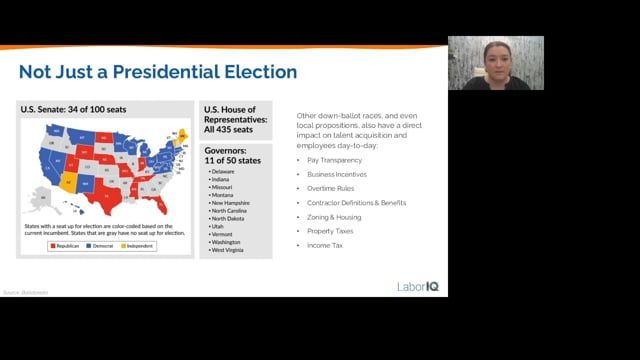
- Down-ballot and local races often matter more directly to employers than the presidential race itself — pay transparency laws, contractor classification rules, zoning and housing policy, and local tax measures are shaped at the state and municipal level, where most businesses actually feel policy impact.
Practical guidance for interpreting economic headlines includes treating monthly jobs reports skeptically, especially when distorted by short-term events like strikes or natural disasters, and recognizing that perceptions of the economy have grown more polarized along party lines even when underlying data tells a more stable story.
The overall message for talent acquisition leaders is to plan around durable labor market trends — cooling but steady hiring, wage pressures, and a shrinking pool of experienced talent — rather than around predictions tied to any single election outcome.