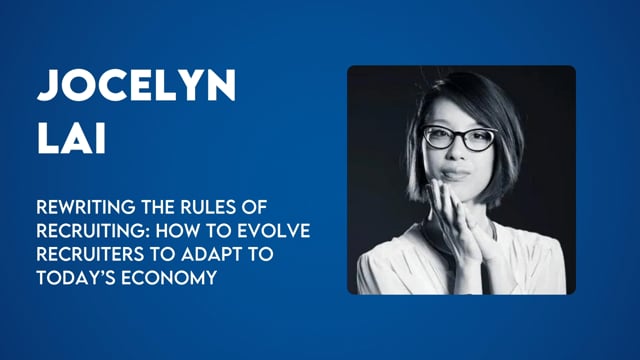
Rewriting the Rules of Recruiting: How to Evolve Recruiters to Adapt to Today’s Economy
May 16, 2024 · ERE Recruiting Conference Spring 2024 ·
Speakers

About this video
Recruiting has always existed in some form, but the pace at which it changes has compressed dramatically, from centuries between major shifts to what now feels like constant disruption. That speed is why so many talent acquisition teams feel perpetually behind, reacting to change instead of anticipating it.
A framework built inside a fast-growing public company offers a way to flip that dynamic, organized around a simple idea: teach recruiting teams to surf instead of just survive the waves. The approach breaks into four steps.
- Identify the three biggest factors likely to trigger change for a TA team. Tracking more than three tends to produce paranoia rather than clarity. For one organization, those factors were what Wall Street values (headcount growth versus profitability), shifts in talent market competitors, and internal team morale.
- Talk openly with the team about how each factor could affect their day-to-day work, even when the conversation is uncomfortable. Recruiters who don't understand the macroeconomic pressures behind hiring freezes or sudden headcount growth tend to feel like change is happening to them rather than something they can prepare for.
- Train the team to recognize early warning signs, turning the burden of watching for disruption into a shared responsibility instead of something only a leader carries alone.
- When a wave actually hits, make a fast, clear decision and move as a team, rather than freezing or scrambling individually.
Putting this into practice meant building financial literacy from scratch for recruiters who had never worked in finance, including quarterly earnings watch parties where the team reviewed reports together, wrote down questions, and worked through unfamiliar concepts like profitability metrics. It also meant connecting recruiters directly with talent management so that a shift toward valuing headcount efficiency could translate into filling roles internally rather than sitting on open requisitions for months, a practice that directly demonstrates value to the business.
The underlying goal is to move a team from reacting to change to anticipating it, so that a hiring freeze, a shift in competitors, or a dip in morale becomes a recognizable pattern rather than a crisis. Teams that learn to spot these signals early are in a far stronger position to protect their own roles and the recruiting function as a whole.