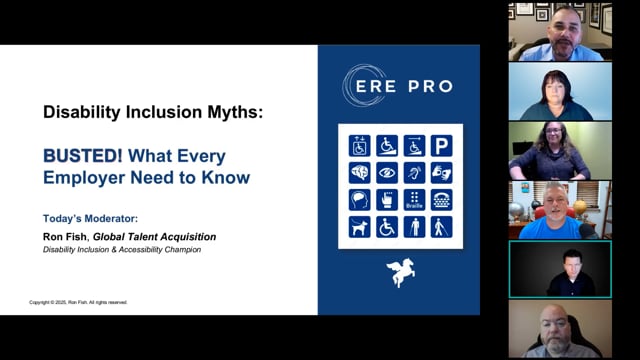
Disability Inclusion Myths: Busted! What Every Employer Needs to Know
May 20, 2025 · Webinars ·




About this video
A panel of talent acquisition professionals and disability inclusion practitioners, including a hiring manager and a jobseeker who is deaf, works through the misconceptions that keep companies from hiring people with disabilities. The conversation moves myth by myth, backed by direct experience from both the employer and employee sides.
Points covered include:
- The claim that employees with disabilities are less productive, countered by the argument that navigating daily barriers builds stronger problem-solving and troubleshooting skills.
- The belief that accommodations are expensive, addressed with examples of free assistive technology, creative use of separate accommodation budgets rather than department funds, and the fact that most accommodations cost very little.
- The assumption that employees with disabilities take more sick leave, challenged with data from an employer managing thousands of employees with disabilities showing strong attendance and loyalty.
- The idea that hiring people with disabilities raises legal risk, flipped to show that inaccessible hiring processes and untrained managers are what actually create legal exposure under laws like the ADA and the Rehabilitation Act.
- The notion that people with disabilities are suited only for limited types of work, rebutted with real examples spanning technical, administrative and skilled trades roles.
Specific accommodation examples come up throughout: split keyboards for limb differences, adjustable or reduced lighting for neurodivergent employees, sign language interpreters for group settings, closed captioning and AI note-taking tools for one-on-one work, wider walkways and larger workspaces, and the option to turn cameras on or off in virtual meetings depending on individual needs.
Global figures on disability prevalence and workplace representation frame the discussion, along with a comparison of how few companies run dedicated disability inclusion programs compared to those focused on gender or race and ethnicity. The overall guidance is practical: treat accommodations as individualized, inexpensive in most cases, and a source of stronger retention and problem-solving rather than added risk.